Difficult Conversations: How to Move Past The Cushion and The Hammer into The Sweet Spot
Key Takeaways
The Power Distortion: Difficult conversations rarely derail because leaders lack the right words; they derail because leaders overlook how their positional power amplifies anxiety and filters truth.
The Two Extremes: Leaders typically default to The Cushion (diluting truth out of discomfort, or "Ruinous Empathy") or The Hammer (using positional authority to force short-term compliance).
The Sweet Spot: True psychological safety means pairing ambitious expectations with unconditional dignity using a four-part framework: audit your power shadow, name the dynamic, anchor in observable behavior (SBI+E), and inquire like a scientist.
If you have been holding on to a hard conversation for days—or even weeks—take a deep breath.
Hesitation doesn't make you a weak leader. It makes you a human who cares deeply about your people and your culture, and who wants to avoid causing unnecessary harm.
Whether you are leading a department, managing a faculty team, or guiding an executive suite, the hardest part of leadership is often sitting across from someone you value and addressing a gap between expectations and reality. We worry about damaging relationships, triggering defensiveness, or worsening existing burnout. To compensate, we over-prepare our talking points.
Tough conversations rarely derail due to a lack of preparation. They derail because, in their preparation, leaders forget to consider the weight of their own power in the room.
Positional power changes the environment:
What you say carries amplified weight.
Your nonverbal micro-expressions are closely monitored.
Your authority directly shapes how safe someone feels responding honestly. (psychological safety)
Leading intentionally means cultivating self-awareness about how your power affects others and pairing that awareness with empathy during difficult conversations.
The Two Traps: The Cushion vs. The Hammer
When stepping into a high-stakes conversation without examining our power, we usually fall into one of two common traps:
1. The Cushion (Diluting Truth Out of Kindness)
When we fear coming across as heavy-handed, we soften the message so much that the other person leaves confused about what actually needs to change.
In Radical Candor, Kim Scott describes this dynamic as Ruinous Empathy: caring personally while failing to challenge directly. Protecting someone from short-term discomfort often produces long-term confusion, missed growth opportunities, and hidden resentment.
2. The Hammer (Using Authority to Force Compliance)
When leaders lean on positional authority rather than relational trust, they turn what should be a dialogue into an interrogation, mistaking dominance for decisive leadership.
As Aiko Bethea (author of Anchored, Aligned and Accountable) points out, when power goes unexamined, leaders judge interactions strictly by their own intent. The result? Team members shut down and protect themselves. Forcing short-term compliance breeds long-term resistance and destroys psychological safety.
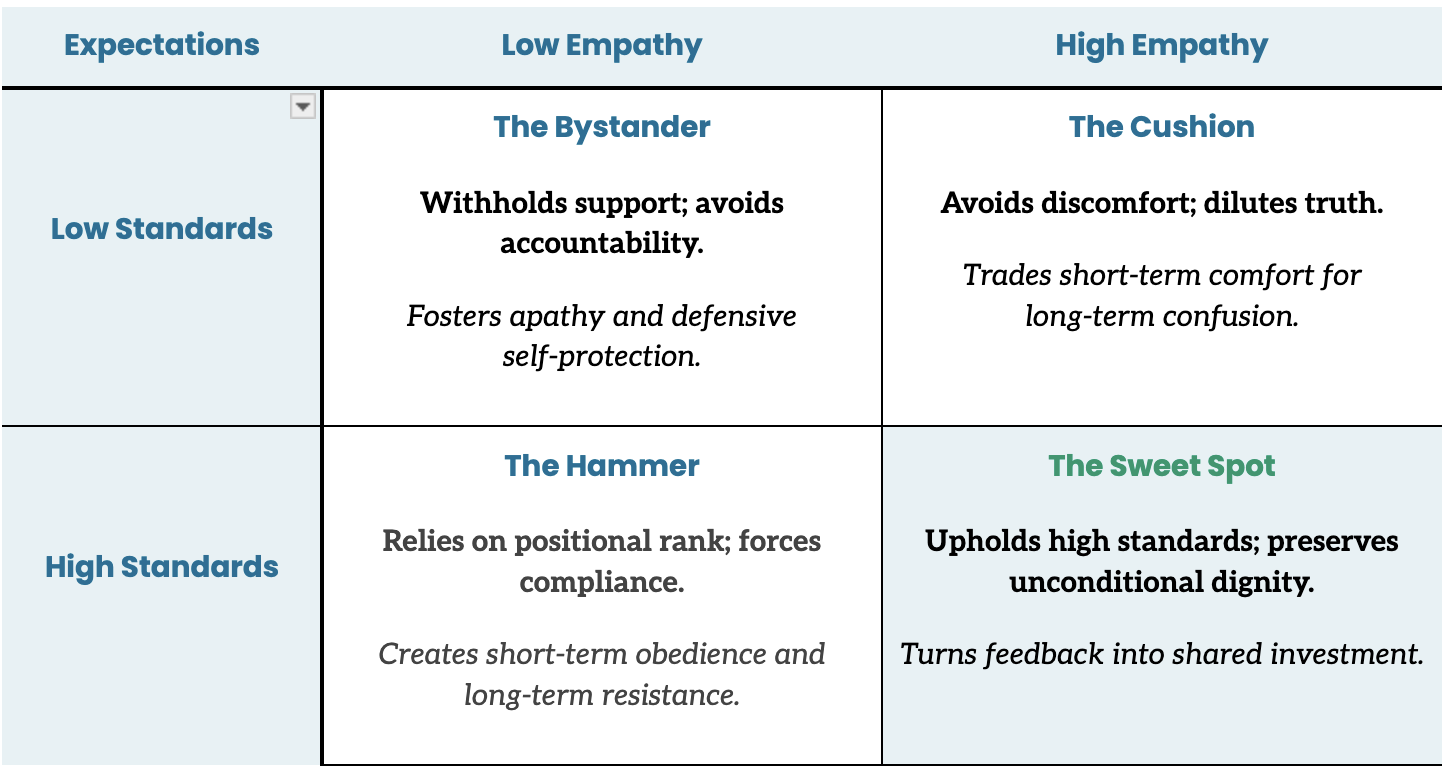
The Standards vs. Empathy Matrix
A third path exists: The Sweet Spot (Pairing High Standards with Deep Safety). When we bring both self-awareness and courage into the room and balance rigorous challenge with genuine support, we transform feedback from an existential threat into a shared investment.
Organizational psychologist Adam Grant notes that high-performing, high-trust teams never dilute expectations to keep people comfortable; instead, they build environments where ambitious standards meet unconditional dignity.
The Standards vs. Empathy Matrix
©2026, Peak Leaders Collective
The 4-Step Framework for Power-Aware Conversations
To bridge the gap between compassion and clarity, anchor your next high-stakes conversation in this four-part practice:
1. Audit Your Power Shadow
Before scheduling the meeting, spend five minutes examining the invisible weight you carry into the meeting:
Position: What formal authority or organizational capital do I hold in this dynamic?
Perception: How might my title make candid pushback feel risky for them?
Intent: Am I entering this room to protect my ego and be "right," or to invest in their growth and uphold our shared commitments?
2. Name the Dynamic Out Loud
Lower the defensive barriers by acknowledging the power imbalance directly. Naming what is unspoken diffuses tension and sets an immediate tone of partnership:
"Before we dive in, I want to acknowledge that when a manager calls a meeting like this, it can feel fraught. I’m not here to hand down a directive or play 'gotcha.' I’m here because I care deeply about your success and our team’s mission, and I want us to look at this challenge together."
3. Anchor in Observable Behavior, Not Character (The SBI+E Model)
Use the Center for Creative Leadership's Situation-Behavior-Impact (SBI) framework—paired with an intentional empathy bridge—to keep feedback objective, measurable, and free of character judgments:
Situation: Anchor in a specific moment.
"During yesterday's team meeting..."Behavior: Describe observable, objective actions rather than perceived attitudes.
"...when the schedule change was introduced, you dismissed the timeline without proposing an alternative approach."Impact: Outline the operational ripple effect.
"...it stalled our momentum and left the team hesitant to voice their input."Empathy: Validate their context before moving forward.
"I know you’ve been stretched thin across multiple deadlines this week."
4. Shift from Proving to Inquiring
Channel Adam Grant’s guidance to "think like a scientist": treat your perspective as an opening hypothesis rather than an absolute verdict. Pause, hand over the floor, and ask questions focused on discovery:
"Help me understand what was happening on your end when that timeline was presented."
"What constraints or roadblocks am I missing from where I sit?"
"What clarity or support do you need from me so we can realign with our shared team agreements?"
Culture Is Built One Conversation at a Time
Crucial conversations are never administrative boxes to check on a managerial to-do list; they are the exact moments where team culture takes shape. Every time you address an operational gap with empathy and dignity, you demonstrate that accountability is an act of deep investment rather than a punitive measure.
At Peak Leaders Collective, we believe that holding people to high standards while honoring their humanity is one of the highest forms of respect a leader can offer.
Leadership does not require abandoning your authority or wielding it like a blunt instrument. When you enter the room aware of your power shadow, lead with curiosity, and match high expectations with psychological safety, you transform what once felt like an interpersonal threat into the foundation of durable trust.
Frequently Asked Questions (FAQs)
What is the difference between "The Cushion" and "The Hammer" in feedback?
"The Cushion" occurs when a leader softens difficult feedback so extensively that the recipient fails to grasp the real issue, prioritizing short-term comfort over clarity (similar to Kim Scott's concept of Ruinous Empathy). "The Hammer" occurs when a leader relies purely on positional authority to demand compliance, which produces short-term obedience while damaging long-term trust and psychological safety.
How does positional power affect difficult conversations?
Positional power amplifies how employees interpret a leader's tone, body language, and word choice. When power dynamics are unaddressed, employees perceive open dissent as professionally risky, leading to self-protection, silence, and filtered feedback.
What is the SBI+E model for employee feedback?
The SBI+E model builds on the Center for Creative Leadership's framework (Situation, Behavior, Impact) by adding an explicit Empathy step. Leaders outline the specific context (Situation), cite the objective action (Behavior), explain the operational outcome (Impact), and validate the employee's pressures (Empathy) before opening a two-way dialogue.